Understanding Electric Motors in Smart Height-Adjustable Desks

Updated: Oct 21, 2025
In the modern workplace, the smart height-adjustable desk has evolved from a niche product into a cornerstone of ergonomic design. By seamlessly transitioning from a sitting to a standing position, these desks empower users to improve their health, posture, and productivity. The seemingly effortless movement, initiated with the press of a button, relies on a sophisticated internal mechanism. For many, a simple question arises: what type of motor makes it all possible? Is it a traditional DC motor, a modern brushless DC motor, or a precision-oriented stepper motor? The answer is more nuanced than a single component and involves a deeper understanding of the technologies that power these intelligent workstations.
The Fundamentals of Electric Motors
To fully appreciate the engineering behind a smart height-adjustable desk, it is essential to first understand the three primary types of motors and the fundamental principles that govern them.
Brushed DC Motors: The Workhorse of Electromechanical Devices
A direct-current (DC) motor is a classic electrical machine that transforms electrical energy into mechanical energy through the interaction of magnetic fields and electrical currents. At its core, a DC motor consists of two main components:
Stator (stationary part)
- Responsible for generating a fixed magnetic field
- Uses either permanent magnets or field windings
Rotor (rotating part, also called the armature)
- Wrapped in coil windings
- Rotates within the magnetic field created by the stator
The principle of operation is based on Lorentz's force law, which states that a current-carrying conductor placed within a magnetic field experiences a force perpendicular to both the magnetic field and the current's direction. To ensure continuous rotation, the motor uses a mechanical switching system called a commutator and brushes. As the rotor spins, the brushes make sliding contact with segments of the commutator, which periodically reverses the direction of the current in the rotor's windings. This process, known as commutation, ensures that the magnetic fields constantly interact in a way that generates sustained torque and keeps the motor shaft turning in one direction. The speed of a DC motor can be controlled by simply changing the voltage applied to the armature.

Advantages and Limitations of Brushed DC Motors
Advantages
- Valued for their straightforward design
- Lower manufacturing costs
- High torque density
- Perform well when starting and regulating speed
Limitations
- Physical contact between the brushes and the commutator creates friction
- This leads to:
- Mechanical wear
- Sparks
Brushless DC (BLDC) Motors: The Modern Alternative
Concept
A brushless DC motor represents an evolution in motor technology. As the name implies, it eliminates the need for physical brushes and commutators by using electronic commutation. This design often inverts the brushed motor structure:
- Permanent magnets are placed on the rotating rotor.
- Windings are placed on the stationary stator.
Operation
Controlled by an external electronic drive, which replaces mechanical brushes. The controller:
- Uses sensors to detect the rotor’s precise position.
- Directs current to the stator windings in a timed sequence.
- Creates a rotating magnetic field that the rotor’s magnets follow.
- Adjusts phase and amplitude of current pulses to control speed and torque.
Result: smooth operation with minimal torque ripple.
Advantages
No physical contact between rotor and stator → longer lifespan (limited mainly by bearings).
Low acoustic noise.
Reduced electromagnetic interference.
Minimal maintenance requirements.
High efficiency in converting electrical energy into mechanical work.
Drawbacks
Higher initial cost due to electronic controller.
Added complexity in system design.
Value Proposition
The investment in BLDC technology provides:
- Quieter operation.
- Longer lifespan.
- Virtually no upkeep.
These traits make it a hallmark of a premium product (e.g., in modern adjustable desks or high-performance equipment).
Stepper Motors: The Precision Specialist

A stepper motor is a unique type of brushless, synchronous motor that converts digital pulses into discrete, precise angular movements, or "steps". Instead of rotating continuously, the motor moves in small, incremental steps, dividing a full rotation into a set number of precise angles. This characteristic makes it an ideal choice for applications that demand exact positioning and repeatable movements.
The motor's operation is based on the sequential energizing of its stator windings. Each digital pulse sent to the motor's drive or translator advances the rotor by one step. By controlling the sequence and frequency of these pulses, the motor's direction and speed can be precisely managed. A key feature of a stepper motor is its ability to hold a position with full torque even when stationary, as long as the windings are energized. Stepper motors are often used in "open-loop control" systems, which means they do not require an external feedback sensor to know their position, simplifying their control and reducing system cost. This level of precision is critical for applications like 3D printers, CNC machines, and robotics.
Core Differences Between Motor Types
A summary of the core differences between these three motor types can be found in the table below.
DC Motor BLDC Motor Stepper Motor Comparison for Electromechanical Applications
Characteristic | Brushed DC Motor | Brushless DC (BLDC) Motor | Stepper Motor |
Commutation | Mechanical (Brushes/Commutator) | Electronic (Solid-State Drive) | Electronic (Sequential Pulses) |
Motion | Continuous Rotation | Continuous Rotation | Discrete Steps |
Efficiency | Lower (Friction Loss) | Higher (No Friction Loss) | Low (Constant Current Draw) |
Lifespan | Shorter (Brush Wear) | Longer (Limited by Bearings) | Longer (No Brushes) |
Noise Level | Higher (Friction, Arcing) | Very Low | Higher (Vibration/Microstepping) |
Cost | Lower (Simpler Build) | Higher (Requires Controller) | Higher (Complex Build) |
Primary Use Case | General-purpose, low-cost applications | High-performance, long-life applications | Precision positioning, robotics, 3D printing |
The Answer: Which Motors Power Your Desk?
The question of which motor type a smart height-adjustable desk uses cannot be answered by simply pointing to a single component. The motor is part of a larger, integrated system.
Beyond the Motor: The Role of the Linear Actuator
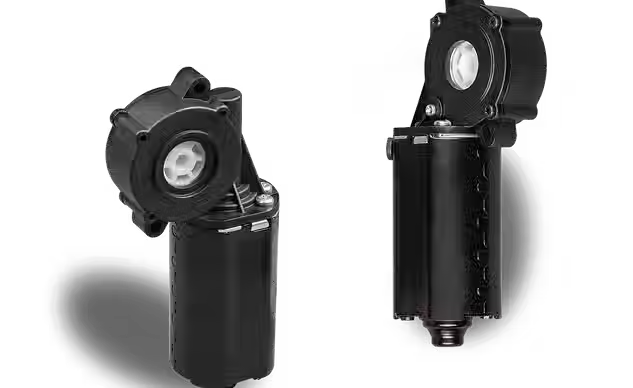
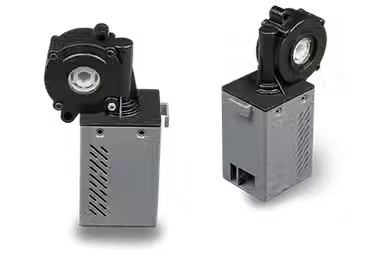
A smart height-adjustable desk does not rely on a standalone motor for lifting. Instead, it utilizes an electric linear actuator, also known as a lifting column. This system is a self-contained unit specifically designed to convert the rotary motion of a motor into a straight-line, or linear, pushing or pulling force. The actuator's primary components include a DC or BLDC motor, a series of gears, and a lead screw with a driving nut.
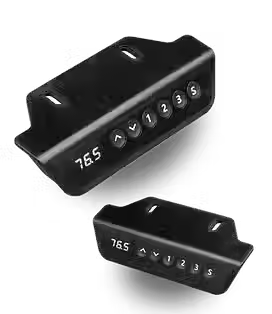
The motor's rotation drives the lead screw, causing the internal nut to travel up or down its length. This motion extends or retracts the desk leg, providing the necessary lifting force. The lifting column is a fully integrated system, designed with all the necessary components to work together seamlessly. This holistic, system-based approach explains why modern desks include features like programmable presets, anti-collision systems, and low standby power consumption, which are managed by a central control box rather than being inherent to the motor alone. This interconnected design is a defining characteristic of a high-quality "smart" desk.
Why You Don't See Stepper Motors in Desks
Despite being a brushless technology, stepper motors are fundamentally unsuited for the demands of a height-adjustable desk due to several key design characteristics.
1. Reliability and Step Loss
Stepper motors are designed for high-precision, open-loop positioning.
Weakness: risk of “step loss” if the load exceeds motor torque → leads to positioning errors.
For a desk holding expensive equipment, this is a significant reliability risk.
By contrast, linear actuators are designed with:
- Closed-loop systems
- Limit switches
- Overload protection → Prevent stalling and ensure safe, reliable operation.
2. Energy Efficiency
Stepper motors are highly inefficient for applications that spend most of the time stationary.
To maintain a fixed position, their windings must remain energized with constant current.
This makes them less energy efficient than other motor types.
Contradicts the energy-saving features (e.g., standby power < 0.1W) promoted in modern smart desks.
3. Motion Quality and Noise
While stepper motors can be precise, they are not ideal for continuous, fast, and quiet desk motion.
Their stepping motion can create noise and vibration, undesirable in professional or home environments.
DC motors and BLDC motors offer:
- Superior efficiency
- Higher speed
- Better acoustic performance → Making them the clear choice for desk applications.
Brushed vs. Brushless: The Real Choice in Standing Desks

The actual technological debate in the standing desk industry is not about stepper motors but rather the choice between brushed DC and brushless DC (BLDC) motors.
Brushed DC motors are typically found in more affordable, entry-level standing desks. They offer a simple, cost-effective solution but come with the inherent limitations of physical wear on the brushes and commutator, which can lead to a shorter lifespan, higher maintenance needs, and more audible noise.
BLDC motors are the standard for premium, high-end "smart" desks. Their use of electronic commutation eliminates the primary failure points of brushed motors, resulting in a significantly longer operational lifespan, minimal maintenance, and quieter operation, often below 45 dB. Although the initial cost is higher due to the complex electronics, the enhanced durability, reliability, and smooth, quiet user experience make them a worthwhile long-term investment.
Single-Motor vs. Dual-Motor: The Performance Divide
Single-Motor System
Mechanism: Uses one motor to drive both legs, typically via a hex rod.
Cost: Generally more affordable.
Capacity: Suitable for light office setups, with a lower weight capacity (≈ 100–150 lbs).
Performance: May offer slower speeds, can be more susceptible to uneven wear over time.
Dual-Motor System
Mechanism: Features a motor in each leg.
Capacity: Higher weight capacity (≈ 250–350 lbs or more), ideal for heavy workstations with multiple monitors.
Performance: Faster and smoother adjustments, improved stability, reducing wobbling at taller heights.
Standing Desk System Comparison
Feature | Single-Motor System | Dual-Motor System | Comments & Insights |
Load Capacity | Average (100–150 lbs) | Strong (>250 lbs) | Capacity is highly dependent on motor quality. |
Lifting Speed | Slower | Faster & Smoother | Speed consistency under load is a key indicator of quality. |
Stability | Fair (Risk of Uneven Wear) | Good (Balanced Weight Distribution) | Important for dual-monitor or heavy setups. |
Cost | More affordable | More expensive | A high-quality single motor can be pricier than a low-quality dual system. |
Ideal For | Light setups, budget-conscious users | Heavy workstations, long-term investment | Dual-motor systems are the mainstream standard for quality desks. |
Conclusion & Expert Recommendations
The choice of motor technology is a critical factor in a smart height-adjustable desk's performance, but it is one component within a larger, integrated linear actuator system. The analysis shows that the primary distinction is between brushed and brushless DC motors, with stepper motors being fundamentally unsuited for this application due to issues with reliability and inefficiency.
For the user seeking a reliable, long-lasting investment, the choice becomes clear:
For the Budget-Conscious User: A single-motor desk with a high-quality brushed DC motor is a suitable and cost-effective option for a light office setup.
For the Power User: A dual-motor desk with BLDC technology is the ideal choice. Its superior stability, higher lift capacity, and enhanced durability make it a necessity for heavy workstations with multiple monitors or other equipment.
For the Discerning Consumer: The discerning user should prioritize a desk with BLDC motors and a reputable brand, regardless of whether it is a single- or dual-motor system. The true measure of a desk's quality is its performance consistency under varying loads, its quiet operation, and its integrated smart features. By focusing on these factors, consumers can ensure their purchase is a reliable and long-lasting addition to their workspace.


Comments