The HDM Actuators for Critical Hospital Bed Functions
Understanding the Role of Medical Grade Actuators in Hospital Beds
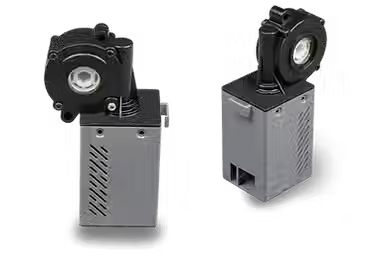
When it comes to hospital beds, most people think of comfort and care. However, the unsung hero behind these features is the medical grade actuator. These precision devices transform beds from flat surfaces into adjustable positions, catering to patient needs. Whether it’s raising the legs for circulation or reclining for comfort, the medical grade actuator plays a pivotal role in patient recovery.

How Medical Grade Actuators Enhance Functionality
You may wonder, how exactly does a medical grade actuator improve hospital beds? These actuators ensure that adjustments are smooth and quiet, allowing for a seamless patient experience. If you’ve ever been in a hospital bed that glides effortlessly into the perfect position, you’ve felt the benefits of a top-quality medical grade actuator at work.
Technological Advancements and Safety Standards
Quality is crucial when it comes to medical grade actuators. Because they directly impact patient safety and comfort, manufacturers adopt rigorous safety standards, ensuring that these mechanical devices perform reliably under various conditions. In emergencies, a responsive actuator can make a significant difference in care.
Improved patient comfort
Enhanced accessibility for staff
Increased safety during adjustments
Feature | Importance |
Smooth Adjustments | Reduces patient stress |
Durability | Ensures longevity |
Safety Compliance | Protects patient well-being |
Key Benefits of Medical Grade Actuators
In summary, integrating high-quality medical grade actuators into hospital beds unlocks numerous benefits. These actuators are not just mechanical devices; they represent a commitment to patient-centered care.
Enhanced recovery experiences
Customized patient positioning
Streamlined nursing workflows
"In every adjustment made, a medical grade actuator carries the weight of patient comfort and safety—truly, a little marvel of engineering."
Why Are Essential for Patient Care
When it comes to patient care, nothing is more crucial than ensuring a hospital bed supports the patient's well-being and comfort. This is where HDM actuators come into play. As a medical grade actuator, they transform traditional beds into advanced, adjustable systems that cater to a patient’s specific needs. Imagine a bed that not only adjusts for optimal comfort but also facilitates critical medical processes. It’s this precision that can make all the difference in a hospital setting. Want to explore more? Head over to our homepage and see what we have to offer!

The Role of HDM Actuators in Healthcare
In hospitals, time and accuracy are of the essence. HDM actuators provide seamless motion, allowing caregivers to reposition patients quickly and safely. The technology embedded in these medical grade actuators ensures that every movement is intentional and smooth, reducing the risk of injury to both patients and medical staff. Have you ever struggled with a manual bed adjustment? With HDM actuators, those worries are a thing of the past.
Key Features of HDM Actuators
So, what makes HDM actuators the cornerstone of advanced hospital beds? Here are some key features:
Precision movement control
Durability for long-term use
Silent operation for a peaceful environment
Feature | Benefit |
Precision Control | Enhanced patient comfort and safety |
Durability | Reduced replacement costs |
Silent Operation | Minimized disruptions during recovery |
“With HDM actuators, we are not just moving beds; we are elevating patient care.”
Key Features of Medical Grade Actuators for Hospital Use
When it comes to hospital beds, the technology behind medical grade actuators plays a pivotal role in enhancing patient care and comfort. These specialized actuators are engineered not just for movement but for precision, reliability, and safety—qualities that are non-negotiable in critical healthcare settings. Imagine the peace of mind that comes from knowing that the bed functions seamlessly at the touch of a button, making life easier for both patients and caregivers alike. The medical grade actuator truly is at the heart of this innovation.

Durability and Reliability
These actuators must withstand the rigors of daily hospital use. With frequent adjustments required for positioning, they need to be robust and durable. The last thing anyone wants is an actuator malfunction in an emergency situation. Manufacturers ensure that medical grade actuators meet rigorous standards, providing a safety net that reassures everyone in the hospital environment.
Precision Control
Precision is the name of the game. Medical grade actuators allow caregivers to adjust bed positions with exacting control. This means that whether it's to elevate a patient's head or adjust for comfort, the adjustments can be made accurately, enhancing patient well-being. It’s fascinating how technology transforms such basic needs into highly efficient operations!
Engineered for safety and reliability
Quiet operation to maintain a calming environment
Easy integration with existing hospital systems
Using such actuators promotes therapeutic benefits and fosters an engaging atmosphere, which is essential in care settings.
Feature | Description |
Material | Corrosion-resistant for hygiene |
Control | Remote options for easy access |
Weight Capacity | Designed for various patient weights |
“The right medical grade actuator can turn a hospital bed into an oasis of comfort, making it vital to choose wisely.”
Comparing Medical Grade Actuators with Standard Options
When it comes to hospital equipment, precision is non-negotiable. Medical grade actuators are designed specifically for critical tasks, such as adjusting hospital beds for patient comfort and safety. Unlike standard options, which may falter under heavy use, medical grade actuators offer reliability and performance tailored to medical settings. This is just one of many great blogs we have—explore more right here.
Why Choose Medical Grade Actuators?
You might wonder, why should I invest in medical grade actuators instead of standard ones? The answer lies in their rigorous testing and certification processes. Medical actuators must meet stringent healthcare regulations, ensuring they operate smoothly under various conditions. Think of them as the fine-tuned instruments in a maestro's orchestra—each component is essential for harmonious performance.
Key Differences
The differences are stark when comparing these actuators. Standard actuators may suffice for general applications, but in a hospital, the stakes are much higher. Medical grade actuators provide superior durability, safety features, and performance consistency, evident in their design and mechanism.
Durability under stress
Compliance with health regulations
Advanced safety features
Customizable for specific functions
For instance, when a hospital bed needs to adjust quickly for emergency situations, using a standard actuator could lead to failure or malfunction. A medical grade actuator ensures quick and reliable response times.
Feature | Medical Grade Actuator | Standard Actuator |
Durability | High | Moderate |
Regulatory Compliance | Yes | No |
Response Time | Fast | Slow |
The Bottom Line
Using the right actuator in a hospital can literally be a matter of life and death. The choice is really clear; medical grade actuators are the unsung heroes behind the scenes. So, think of them like the backbone of healthcare machinery.
In the realm of patient care, every component counts. Make yours a medical grade actuator.
How Medical Grade Actuators Enhance Safety and Reliability
When it comes to the intricate mechanics of hospital equipment, the medical grade actuator stands out as a paramount component. These actuators are meticulously designed to ensure precision and reliability in critical functions, especially in hospital beds. The safety of patients hinges on the performance of these devices. A malfunctioning actuator could mean the difference between a restful night and a medical emergency. So, understanding how these devices work is essential for healthcare providers and engineers alike.
The Necessity of Precision
In a hospital setting, every detail matters. Medical grade actuators provide the precise control necessary for adjusting bed positions that enhance patient comfort and ease of access for healthcare professionals. For example, the ability to articulate a bed smoothly can impact how easily a patient can transition between sitting and lying down. And let’s face it—any sudden jerk in motion can cause distress not only to the patient but also to the staff who are assisting them.
Reliability Under Pressure
Medical grade actuators are built to withstand the rigors of a clinical environment. They’re designed not just for performance but for longevity as well. You wouldn’t want an actuator to stop working just when it’s needed the most. This reliability is crucial, especially in high-demand situations. Moreover, these actuators are subjected to rigorous safety standards, ensuring that each component meets—or exceeds—healthcare compliance requirements.
Durable materials that resist wear and tear
Consistent and accurate control capabilities
Low maintenance requirements
Feature | Standard Actuator | Medical Grade Actuator |
Durability | Moderate | High |
Precision | Average | Excellent |
Compliance | Variable | Meets Medical Standards |
Benefits of Medical Grade Actuators
The list of advantages for using medical grade actuators is extensive. From enhancing patient care to simplifying operations for medical staff, these devices play a crucial role. They can also minimize operational costs by reducing maintenance needs. Let’s explore a few key benefits:
Improved patient experience
Increased operational efficiency
Reduction in equipment failures
“Quality actuators not only save lives—they enhance the overall healthcare experience.”
Ultimately, incorporating high-quality medical grade actuators into hospital beds translates into a safer environment for patients, which is something we all strive for in healthcare.
Innovations in Medical Grade Actuators for Advanced Hospital Systems
Innovations in medical grade actuators have transformed the landscape of hospital systems, especially when it comes to critical functions like hospital beds. Imagine a hospital bed that responds to the gentle touch of a button, seamlessly adjusting to a patient’s needs. The convergence of precision engineering and healthcare has given us the gift of these actuator technologies, ensuring optimal patient care and enhanced functionality for medical staff. Each medical grade actuator plays a pivotal role in providing comfort and safety, making it an essential component in today’s advanced healthcare environment.
The Impact on Patient Care
One of the most remarkable features of modern medical grade actuators is their ability to greatly impact patient care. For instance, consider how slight adjustments to bed height can influence a patient’s comfort and safety. By integrating state-of-the-art medical grade actuators into patient beds, healthcare providers can ensure that patients receive the precise support they need, reducing strain during transfers and enhancing overall recovery.
Key Features of Medical Grade Actuators
Modern medical grade actuators boast a slew of features that take hospital systems to a higher level. These include:
Precision controls for easy adjustments
Low noise operation to maintain a serene environment
Durability designed to withstand the rigors of medical environments
Smart technology integrations for enhanced functionality
Compact designs suitable for various bed configurations
Feature | Benefit |
Precision Controls | Allows for exact adjustments, enhancing patient comfort |
Low Noise | Creates a peaceful atmosphere conducive to healing |
Durability | Ensures long-lasting performance under demanding conditions |
Smart Technology | Fosters integration with other hospital systems for improved care |
Compact Design | Facilitates implementation in varied bed types |
Looking Ahead
The future of healthcare is indeed bright with the continuous advancements in medical grade actuators. As technology evolves, we can expect even more revolutionary features that enhance patient care. Just think—what if your bed could automatically sense a patient’s discomfort? The potential is limitless.
Anticipatory Care Mechanisms
Retrofit options for existing beds
AI-driven data insights for patient monitoring
More customizable settings for patient preferences
Innovations in medical grade actuators are defining the new standard of care, transforming beds into responsive systems that prioritize comfort and safety.
Regulatory Standards for Medical Grade Actuators in Healthcare
In the labyrinth of healthcare technology, the medical grade actuator stands as a silent hero, driving critical functions from hospital beds to surgical equipment. These actuators operate under stringent regulatory standards, ensuring both safety and reliability. Each actuator is designed to meet specific guidelines set by regulatory bodies such as the FDA, which emphasizes the importance of performance and risk management.
Essential Compliance and Testing
The road to compliance is paved with rigorous testing phases for medical grade actuators. These tests evaluate safety, efficacy, and environmental resilience. Imagine designing an actuator that not only lifts a hospital bed but does so under load for an extended period without faltering. That’s where in-depth compliance testing comes into play, simulating real-world scenarios.
Benefits of Robust Standards
With robust standards, healthcare providers can focus on patient care rather than concern for equipment failure. A high-quality medical grade actuator ensures consistent performance, which can make all the difference during critical moments. Without these regulations, we risk compromising patient safety.
Enhanced patient safety
Reliability in mechanical operations
Long-term cost savings through fewer failures
Actuator Type | Compliance Standard | Application |
Linear Actuator | ISO 13485 | Hospital Beds |
Rotary Actuator | IEC 60601 | Surgical Equipment |
"In healthcare, we trust technology with lives; every actuator must earn that trust." - Industry Expert
Conclusion: The Future of Medical Grade Actuators in Healthcare
The role of medical grade actuators in healthcare is evolving, and it’s fascinating to see how these devices can enhance critical hospital functions. I often think about how these precision tools subtly yet significantly improve patient care and operational efficiency. Imagine a scenario where a nurse can effortlessly adjust a hospital bed using a simple touch. That’s the magic of modern medical grade actuators—they are increasingly becoming the unsung heroes in the healthcare setting!
Technological Advancements
As we move forward, the fusion of technology and healthcare continues to advance. Medical grade actuators are integrating with smart technologies, allowing for real-time data collection and patient monitoring. This is not just about convenience; the ability to provide responsive care that adapts to a patient's needs is revolutionary. It’s like having a guardian angel ensuring optimal comfort at all times!
Impact on Patient Care
Let’s not forget the emotional aspect. When patients are in a comfortable environment, their healing process accelerates. Medical grade actuators ensure this comfort by allowing fine adjustments that cater to individual needs. This personalized approach enhances trust between caregivers and patients, fostering a healing atmosphere.
Improved patient comfort
Increased operational efficiency
Seamless integration with healthcare technology
Real-time monitoring
Enhanced safety protocols
Healthcare is a complex landscape, and medical grade actuators are pivotal in simplifying and enhancing many processes.
Aspect | Benefit |
Precision Control | Exact adjustments for patient comfort |
Durability | Long-lasting in demanding hospital environments |
Customization | Tailored solutions for various patient needs |
The Road Ahead
The future looks promising, and I believe we're just scratching the surface of what’s possible with medical grade actuators. As more facilities adopt these technologies, the standards of patient care will reach new heights.
Increasing use in telehealth
Potential integration with AI
Greater focus on ergonomics
Advancements in automation
Continual feedback mechanisms for improvement
The future is not just about advanced technology; it's about creating an environment where patients feel cared for, and medical grade actuators are key players in achieving that vision.
FAQ: Common Questions About Medical Grade Actuators
Medical grade actuators are crucial in ensuring smooth functionality for hospital beds and other healthcare equipment. They provide precision control, allowing caregivers to adjust beds for patients' comfort seamlessly. When considering their use, many often wonder what differentiates a medical grade actuator from standard ones. It’s essential to note that these actuators meet stringent safety and reliability standards, making them ideal for a hospital environment where every second counts. If you have any questions or are interested in our products, feel free to contact us.
What are the main features of medical grade actuators?
The standout features of medical grade actuators include their robustness, reliability, and noise reduction. They are designed to withstand rigorous use, ensuring longevity and dependability. Moreover, they operate with minimal noise, ensuring a tranquil environment for patients. These actuators are often engineered to meet specific healthcare regulations, enhancing their suitability for critical applications.
Are there different types of medical grade actuators?
Indeed, different types of medical grade actuators cater to various functions. Electric linear actuators, for instance, are popular in hospital beds, while rotary actuators might be found in surgical tables. Each actuator type offers unique benefits tailored to specific medical applications.
Linear actuators for adjustable beds
Rotary actuators for surgical tables
Custom actuators for specialized devices
Type | Application | Benefits |
Linear Actuators | Hospital Beds | Precision control, high load capacity |
Rotary Actuators | Surgical Tables | Compact size, smooth operation |
Custom Solutions | Specialty Medical Devices | Tailored functionality, optimal performance |
How do I choose the right actuator for my needs?
Choosing the right medical grade actuator involves understanding your specific requirements, like load capacity and motion type. You'll also want to consider environmental factors, such as exposure to moisture or cleaning agents. Remember that safety and compliance with regulations should always be top of mind.
Assess load requirements
Evaluate space constraints
Ensure regulatory compliance



Comments